17+ Years of Personalized Eye, Nose & Lifting Plastic Surgery in Gangnam, Seoul

Medical Guide
Upper Blepharoplasty: Removing Excess Upper-Eyelid Skin
Learn how upper blepharoplasty removes excess upper-eyelid skin to reduce hooding, when it is functional or cosmetic, plus recovery and realistic risks.
Schedule a ConsultationUpper Blepharoplasty: Removing Excess Upper-Eyelid Skin
Medically reviewed by Dr. Kiweon Ham, Board-Certified Plastic Surgeon in South Korea, Chief Director, Gonggan Plastic Surgery
As the years pass, the thin skin of the upper eyelid can stretch, and the tissues that support it can weaken. The result is often a fold of loose skin that drapes over the lash line, sometimes described as "hooding." For some people this is purely a matter of appearance; for others it begins to sit heavily on the eye and can even crowd the edges of their field of vision. Upper blepharoplasty is the surgical procedure that addresses this excess tissue. This guide explains what the operation involves, who tends to be a candidate, how the incision is planned within the eyelid crease, what recovery generally looks like, and the realistic risks every patient should understand before deciding.
Upper eyelid surgery is one of the most commonly performed operations on the face, but "common" does not mean "one-size-fits-all." Eyelid anatomy varies enormously from person to person, and a careful, individualized plan matters far more than any single technique. If you are weighing this procedure, use this article to prepare thoughtful questions for a qualified surgeon rather than as a substitute for a personal assessment.
What Is Upper Blepharoplasty?
Upper blepharoplasty is a surgical procedure that removes excess skin from the upper eyelid and, when appropriate, adjusts a strip of the underlying muscle or a small amount of orbital fat. According to the American Society of Plastic Surgeons, eyelid surgery can be performed on the upper lids, the lower lids, or both, and the upper eyelid is typically corrected through an incision placed within the natural crease of the lid.
The goal is to reduce the heavy, folded appearance of the upper lid and, where relevant, to open up the eye so that the lid margin is no longer obscured. It is important to be clear about what the surgery does and does not do. Upper blepharoplasty addresses the skin and soft tissue of the eyelid itself. It does not lift a drooping eyebrow, and it does not, on its own, correct a lid that sits too low because of a weak lifting muscle. Those are separate concerns with separate solutions, which is one of the reasons a thorough consultation is so important. At Gonggan Plastic Surgery, eyelid procedures are among the practice's areas of focus, and a personalized evaluation is used to match the right approach to each patient's anatomy.
Functional Versus Cosmetic Upper Blepharoplasty
One of the first things a surgeon will try to establish is whether your concern is functional, cosmetic, or a mixture of both. The distinction is genuinely useful, not just a formality.
A cosmetic upper blepharoplasty is performed to refresh the appearance of the eyes, softening the tired or heavy look that excess upper-lid skin can create. The eyelid crease may look crisper, and eye makeup may sit differently afterward.
A functional upper blepharoplasty becomes relevant when the overhanging skin is severe enough to interfere with vision, particularly the upper and outer parts of the visual field. When redundant skin rests on the lashes or partially covers the lid margin, some people compensate by raising their brows or tilting their head back, which can contribute to fatigue or forehead strain. Mayo Clinic notes that sagging eyelids can, in some cases, reduce side vision, and that removing excess tissue may help restore a clearer field of view when it is medically appropriate.
Because the same operation can serve both purposes, it is worth asking your surgeon directly which category your case falls into, and why. That answer shapes the surgical plan, the way results are discussed, and, in some healthcare systems, whether any part of the procedure could be considered reconstructive. Insurance and coverage rules vary widely by country and policy, so anything relating to cost or coverage should be confirmed directly with the clinic and your insurer.
Are You a Candidate?
There is no single profile of the "right" candidate, but several themes come up repeatedly during consultations. People who consider upper blepharoplasty often have loose or redundant upper-eyelid skin, a heavy or hooded fold, or a feeling that their eyes look tired even when they are well rested. Some notice that the skin has begun to rest on the lashes.
General good health matters, because this is real surgery with real recovery. During your consultation, expect a detailed history and examination. A careful surgeon will look at the position of your eyebrow, the height and symmetry of the eyelid crease, the strength of the muscle that lifts the lid, the quality and quantity of excess skin, and the health of the eye surface. This last point is important: a history of dry eyes, previous eye surgery, thyroid eye disease, or certain other conditions can influence both candidacy and technique.
The evaluation also separates upper blepharoplasty from two things it is sometimes confused with. If the underlying problem is a droopy eyebrow pushing skin downward, a brow-focused approach may be more appropriate than, or complementary to, eyelid surgery. If the lid margin itself sits low because the levator muscle is weak, that points toward ptosis correction rather than simple skin removal. A good assessment sorts out which of these mechanisms, or which combination, is producing the appearance you want to change. To begin that conversation, you can learn more about the practice and request a consultation through the Gonggan Plastic Surgery website.
How the Procedure Works
Consultation and Planning
Planning is arguably the most important stage. With the patient sitting upright, the surgeon marks the natural eyelid crease and estimates how much skin can be safely removed while leaving enough tissue for the eye to close comfortably. Removing too little may leave residual hooding; removing too much can make it difficult to fully close the eye. This balance is why measurement and marking are done so deliberately, and why the plan is customized to each eyelid rather than copied from a template.
The Surgery Itself
Upper blepharoplasty is frequently performed under local anesthesia with or without sedation, though anesthesia choices depend on the individual case, the surgeon's judgment, and whether other procedures are being done at the same time. The specific anesthesia and comfort measures used at any given clinic should be confirmed directly with that clinic.
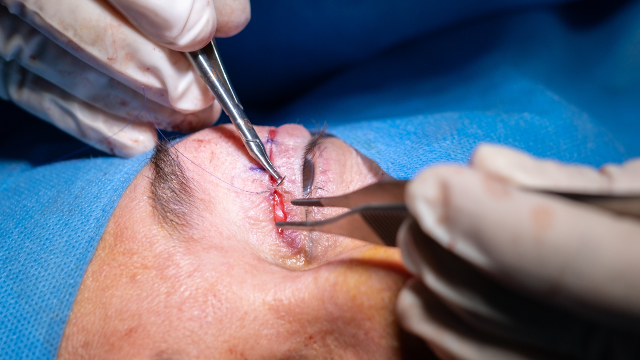
The American Society of Plastic Surgeons describes the core steps: an incision is made within the natural crease of the upper eyelid, which allows the surgeon to remove or reposition fat, adjust muscle if needed, and remove the excess skin. The incision is then closed, usually with fine sutures. Because the incision follows the crease, the resulting scar is designed to sit within the natural folds of the eyelid, where it is generally well concealed once healed. The operation is often completed within a relatively short time, but duration varies with the complexity of the case and any additional procedures performed together.
The Lid-Crease Incision and Scarring
Understanding where the scar goes helps set realistic expectations. In upper blepharoplasty, the incision is placed within, or very close to, the natural upper-eyelid crease. When the eye is open, this line is largely hidden in the fold; when the eye is closed, a fine line may be visible, especially in the early months as it matures.
All surgery leaves a scar, and eyelid skin is among the thinnest on the body, which often heals discreetly. Even so, scar quality depends on factors partly outside anyone's control, including individual healing tendencies, skin type, and how the tissue responds. Early on, the incision line may appear pink or slightly firm before it softens and fades over a period that is typically measured in months, sometimes longer. Following your surgeon's aftercare instructions, protecting the area from the sun, and being patient with the maturation process all support the best possible outcome. No surgeon can guarantee a scar-free result, and any claim to do so should be treated with caution.
Recovery Timeline
Recovery varies from person to person, but a few patterns are common. In the first days after surgery, swelling and bruising around the eyes are expected and often most noticeable during this early window. Cold compresses and keeping the head elevated are frequently recommended to help manage swelling. The American Society of Plastic Surgeons notes that after eyelid surgery, lubricating ointment and cold compresses may be applied, and patients receive specific instructions on eye care, medications, warning signs to watch for, and follow-up.
Many people find that visible bruising fades over one to a few weeks, though this timeline differs widely. Fine sutures placed in the upper lid are often removed within roughly a week, depending on the surgeon's technique and preference. Blurred vision, light sensitivity, watering, or a gritty sensation can occur temporarily as the eyes adjust. Strenuous activity, heavy lifting, and anything that raises blood pressure around the eyes are usually restricted for a period defined by your surgeon. Final results settle gradually as residual swelling resolves and the incision line matures, so the appearance at one week is not the appearance at three months. Your surgeon will give you an aftercare plan tailored to your case; follow it closely and attend your follow-up appointments.
Risks and Complications
Every surgical procedure carries risk, and upper blepharoplasty is no exception. A candid discussion of complications is part of informed consent, and being aware of them helps you recognize what is normal and what warrants a call to your surgeon.
General surgical risks include bleeding, infection, and reactions related to anesthesia. Mayo Clinic lists possible complications of blepharoplasty that include bleeding, infection, dry or irritated eyes, scarring, temporary vision changes, and the need for additional surgery. Several eyelid-specific issues deserve particular attention:
Dry eye and irritation. Eyelid surgery can affect the way the eyelids distribute the tear film, and some patients experience dryness, grittiness, or irritation, which is often temporary but occasionally more persistent. Patients with pre-existing dry eye should raise this during consultation, because it can influence both candidacy and how much tissue is removed.
Lagophthalmos (incomplete eyelid closure). If too much skin is removed, or during the early healing phase, the eye may not close fully. This can leave the eye surface exposed and dry, especially at night. Mild, temporary lagophthalmos may improve as swelling resolves, but a more significant or persistent form can require additional management or revision.
Asymmetry. The two eyes rarely start out perfectly identical, and healing does not always proceed at the same pace or in the same way on each side. Some difference in crease height, fold, or apparent eye opening can occur and occasionally prompts a touch-up procedure.
Over-correction or under-correction. Removing too much skin can create a hollowed or overly tightened look and contribute to closure problems; removing too little can leave residual hooding. This is precisely why conservative, measured planning matters.
Scarring concerns, changes in sensation, and the possibility of revision surgery are also part of the honest picture.
The likelihood and severity of these risks depend on individual anatomy, health, healing, and the specifics of the surgery. A thorough consultation with a qualified surgeon is the setting in which your personal risk profile should be discussed. You can review the credentials and background of Dr. Kiweon Ham before your appointment.
Combining Upper Blepharoplasty with Other Procedures
Because the upper eyelid, the eyebrow, and the lid-lifting muscle all contribute to the look and function of the eye, upper blepharoplasty is sometimes planned alongside other procedures. When brow descent is a major driver of the heaviness, a brow-lifting approach may be considered in addition to, or instead of, skin removal. When a weak levator muscle causes the lid to sit low, ptosis correction may be part of the plan. Some patients also address the upper and lower lids in the same session.
Whether combining procedures makes sense for you is an individualized decision that balances your goals, your anatomy, recovery considerations, and surgical judgment. The point of raising it here is simply that "the eyelid looks heavy" can have more than one cause, and the most durable results come from correctly identifying which mechanism is at work rather than defaulting to a single operation.
Frequently Asked Questions
Will upper blepharoplasty get rid of my under-eye bags?
No. Upper blepharoplasty addresses the upper eyelid only. Puffiness and bags beneath the eye involve the lower eyelid and are addressed with a separate procedure, lower blepharoplasty. During your consultation, your surgeon can assess both areas and explain which one, or both, is relevant to your goals.
Is the scar noticeable?
The incision is placed within the natural upper-eyelid crease, so it is generally well concealed within the fold when the eye is open. A fine line may be visible when the eye is closed, especially in the early months, and it typically softens and fades over time. Healing varies between individuals, and no scar-free result can be promised.
How long does the swelling last?
Swelling and bruising are usually most noticeable in the first several days and often fade over one to a few weeks, though this varies from person to person. Subtle residual swelling can take longer to fully resolve, which is why the final result settles over a period of months rather than days. Cold compresses and keeping the head elevated are commonly recommended early on.
Can I wear contact lenses and makeup afterward?
Your surgeon will advise when it is safe to resume contact lenses, eye makeup, and other activities, and this timing depends on how the incision is healing. Resuming too early can irritate the healing tissue or increase infection risk. Always follow the specific aftercare instructions you are given rather than a general timeline.
Does the procedure change my vision?
When excess skin genuinely obstructs the upper field of vision, removing it may help restore a clearer view, which is the basis for functional blepharoplasty. Temporary blurred vision, watering, or light sensitivity can occur during early healing as the eyes adjust. Upper blepharoplasty is not a treatment for vision problems that originate inside the eye, such as refractive errors.
How long do the results last?
Many patients enjoy long-lasting improvement, but the eyelids continue to age naturally over time, as does the rest of the face. Results are not permanent in the sense of stopping aging, and individual longevity varies. Protecting your skin from sun exposure and maintaining general skin health may support the durability of your result.
The Bottom Line
Upper blepharoplasty removes excess upper-eyelid skin, and sometimes adjusts muscle or fat, to reduce heaviness and hooding of the upper lid.
The procedure can be cosmetic, functional (when excess skin interferes with vision), or a combination of both, and this distinction shapes the surgical plan.
The incision is placed within the natural eyelid crease, so the scar is designed to be discreet, though all surgery leaves some mark and healing varies.
Realistic risks include dry eye, incomplete eyelid closure (lagophthalmos), asymmetry, over- or under-correction, and the possibility of revision.
Results are individualized, are not permanent against ongoing aging, and no specific outcome can be guaranteed; a personal consultation is essential.
This article is provided for general educational purposes only and reflects general information about upper blepharoplasty. It is not medical advice, is not a substitute for a consultation with a qualified surgeon, and is not a self-diagnosis tool. Surgical results vary from person to person based on individual anatomy, health, and healing, and no outcome can be guaranteed. Always discuss your specific situation, candidacy, and risks with a licensed medical professional.
More Articles
Continue reading our clinical guides.

Guide to Nose Surgery: Procedure Basics Explained
Guide to nose surgery: Discover procedure basics, preparation, recovery, and expected results. Learn what to expect and explore your options today.
Learn More

What to Know Before Eye Surgery
What to know before eye surgery: Learn about preparation, risks, recovery, and what to expect for a safer, more confident procedure. Read more today.
Learn More
Revision Rhinoplasty in South Korea: US Patient Guide
A practical guide to revision rhinoplasty in South Korea for US patients: why second nose surgery is more complex, cartilage graft realities, and risks.
Learn More