17+ Years of Personalized Eye, Nose & Lifting Plastic Surgery in Gangnam, Seoul


Eye Surgery
Revision Eye Surgery
Revision eye surgery is a corrective procedure performed to address unsatisfactory outcomes, structural complications, or evolving aesthetic concerns following a previous eyelid surgery.
Schedule a ConsultationWhat Is Revision Eye Surgery and Why Does It Require a Different Approach?

Revision eye surgery — also called revision blepharoplasty or double eyelid revision — is a corrective procedure performed to address unsatisfactory outcomes, structural complications, or evolving aesthetic concerns following a previous eyelid surgery. It is inherently more demanding than primary blepharoplasty because the surgical environment has already been altered by prior procedures: adhesions , scar tissue , reduced skin laxity , and changed tissue planes all require careful individual assessment before a correction can be safely and effectively planned.
Importantly, not every patient seeking revision eye surgery has experienced a surgical failure. Some patients simply want a different fold height or shape as their aesthetic preferences evolve. Others are managing specific structural concerns such as asymmetry , a loosened crease , or an overly dramatic fold . At Gong Gan Plastic Surgery, the starting point for every revision case is thorough communication — understanding exactly why the patient wants revision and identifying the precise anatomical cause — so that the correction delivers genuinely satisfying and lasting change.
Who Is a Candidate for Revision Blepharoplasty?
Revision eye surgery is suitable for patients who have undergone prior eyelid surgery and are experiencing dissatisfaction with the aesthetic result or structural complications. Candidacy is confirmed through detailed clinical evaluation and consultation.
Ideal candidates include:
- Individuals in their 20s–50s with a double eyelid fold that appears overly high, heavy, or dramatic following primary surgery
- Those whose eyelid crease has loosened, lowered, or become less defined over time after prior blepharoplasty
- Patients with visible double scarring from a previous procedure requiring careful adhesion dissection and new crease formation
- Those experiencing eyelid fold asymmetry — where the two eyes display noticeably different fold heights, depths, or shapes
- Patients who feel their prior surgery did not reflect their aesthetic goals or did not account for their individual eye structure
- Those whose eyelid appearance has changed over time due to aging, weight fluctuation, or natural tissue relaxation following prior surgery
- Patients seeking a more natural, proportionate eyelid appearance that better complements their overall facial features
- Individuals in good general health who have allowed adequate healing time since their previous eyelid procedure
Meet Dr. Kiweon Ham — Revision Eye Surgery Specialist at Gong Gan Plastic Surgery

Dr. Kiweon Ham Plastic Surgery Specialist, M.D.
Gong Gan Plastic Surgery is led by Representative Director Dr. Kiweon Ham , a board-certified plastic surgeon with 17 years of clinical experience and one of the most comprehensive facial surgery training backgrounds available in Korea.
Dr. Ham completed his medical degree at Yonsei University College of Medicine and his plastic surgery residency at Severance Hospital . He then undertook advanced fellowships at the University of California San Diego Medical Center (UCSD) and the University of Pittsburgh Medical Center (UPMC) , before returning to Severance as a Former Clinical Instructor in Plastic Surgery . Gong Gan operates as an official partner clinic of Yonsei University Severance Hospital .
He holds Life Membership and serves on the Academic Committee of the Korean Society of Plastic and Reconstructive Surgeons (KSPRS) , presenting regularly at KSPRS international academic conferences to maintain a broad and current clinical perspective. He is also a full member of KSAPS , KCPCA , and IPRAS .
Dr. Ham's philosophy for revision eye surgery centers on honest, objective assessment: recommending only the procedures that are genuinely necessary, communicating the achievable range of correction clearly and accurately, and designing outcomes that reflect each patient's individual anatomy — eye shape, pupil exposure range, skin thickness, and surrounding muscle development — rather than a standardized aesthetic template.
[Book a Consultation with Dr. Kiweon Ham]
Revision Eye Surgery: Case-Based Approaches at Gong Gan
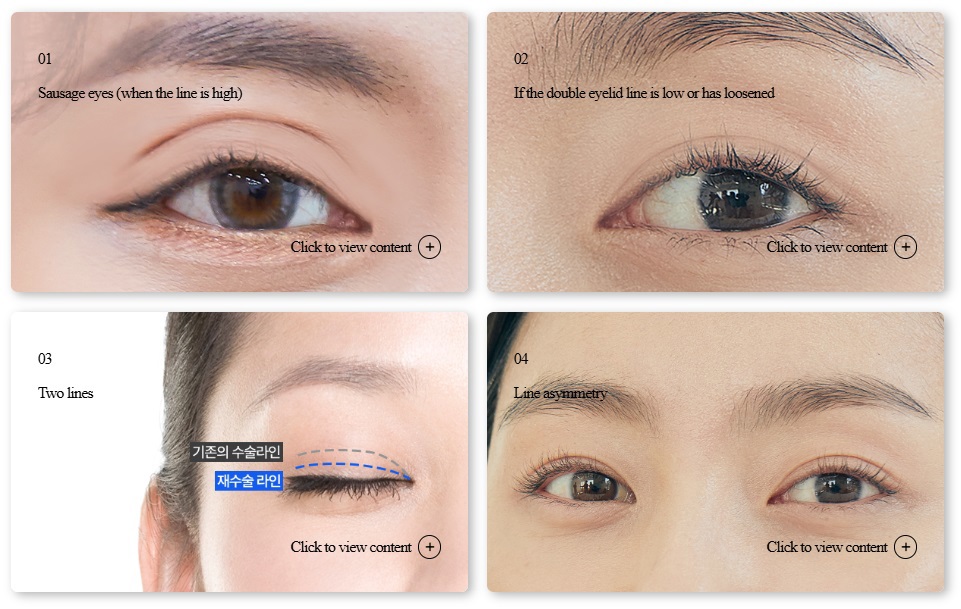
Case 1: High Fold Line — Overly Dramatic Double Eyelid
An excessively high double eyelid crease can create a heavy, unnatural, or overly dramatic appearance. Simply lowering the line significantly carries its own risks — over-correction can create new dissatisfaction over time. Dr. Ham's approach is to identify the precise point at which the fold can be modestly adjusted to reduce the burdened appearance while maintaining long-term visual harmony. This requires a nuanced understanding of eyelid anatomy and a careful eye for proportion — finding the optimal balance rather than applying a maximum correction.
Case 2: Low or Loosened Fold Line
When a double eyelid crease has loosened, lowered, or become poorly defined after primary surgery, the correction must go beyond simply re-creating the fold. Dr. Ham evaluates the patient's eye-opening habits, the development of surrounding orbital muscles, and individual skin characteristics to determine the most appropriate surgical approach. In many cases, additional procedures are needed alongside crease revision to reduce the likelihood of the line loosening again or becoming covered by skin over time.
Case 3: Double Scar Revision
Patients with visible scarring or tissue adhesion from a prior eyelid surgery — sometimes presenting as a double crease or uneven skin texture — require a more technically demanding revision approach. The critical factor is the amount of remaining skin laxity and elasticity. When skin reserve is limited, the existing adhesions from the prior surgery must be dissected more widely and with greater precision than in a standard revision before a new, cleanly defined crease can be established. This procedure requires extensive clinical experience and careful case selection.
Case 4: Eyelid Fold Asymmetry
Asymmetry between the two eyelid folds requires a thorough investigation of the underlying cause before any correction is planned. Differences in skin thickness , subcutaneous fat volume , and skeletal structure between the two sides of the face are natural — and they mean that a uniform correction applied equally to both eyes will not produce a symmetrical result. Dr. Ham identifies the specific anatomical factors driving the asymmetry in each individual case and designs the most harmonious correction accordingly, minimizing the risk of entering a cycle of repeated revisions.
Individual results vary depending on skin condition, tissue elasticity, extent of prior surgery, and healing response. Realistic expectations are discussed in full during pre-operative consultation.
The Revision Eye Surgery Process at Gong Gan Plastic Surgery
- Detailed Clinical Evaluation and Communication: Every revision blepharoplasty consultation begins with a thorough discussion of why the patient is seeking revision — their specific concerns, what they hoped to achieve from their original surgery, and what they want the correction to accomplish. Understanding the patient's motivation and goals precisely is the first and most important step in planning an effective revision.
- Anatomical Assessment and Root Cause Analysis: Dr. Ham evaluates the current eyelid structure in detail — fold height and shape, skin laxity, tissue adhesion, muscle function, pupil exposure, and symmetry — to identify the precise anatomical factors behind the patient's concerns. This analysis determines the most appropriate surgical approach and whether additional procedures are needed alongside the primary correction.
- Personalized Surgical Plan: A fully individualized plan is developed based on the evaluation findings and patient goals. The surgical technique is selected according to the specific case type — fold height adjustment, crease re-creation, adhesion dissection, asymmetry correction, or a combination — with only the procedures that are genuinely necessary included in the plan.
- Revision Eye Surgery Procedure: Dr. Ham performs the surgery directly, using clean, precise incisions and meticulous suturing technique designed to minimize scarring and support rapid tissue recovery. The eyelid fold is designed to complement each patient's individual eye shape, pupil exposure range, and overall facial proportions — not to follow a uniform aesthetic standard.
- Post-Operative Care and Recovery: Swelling and bruising following revision blepharoplasty are expected and typically resolve within one to two weeks, though individual healing timelines vary. A dedicated post-operative management program is provided, with a specialist care coordinator supporting recovery and monitoring progress.
- Follow-Up and Outcome Monitoring: Dr. Ham personally oversees all follow-up appointments. Eyelid fold definition and symmetry become progressively clearer as swelling resolves, with final results continuing to refine over the following weeks and months.
Results, Safety, and Longevity of Revision Blepharoplasty
 |
 |
 |
 |
|---|
Revision eye surgery at Gong Gan is designed for stable, naturally maintained outcomes. By addressing the root anatomical cause of each patient's concern — rather than applying a surface-level correction — the results are built to last. Where necessary, additional supporting procedures are incorporated to reduce the risk of the fold loosening or changing over time.
All procedures are supported by hospital-grade safety systems: operating room CCTV monitoring confirming that Dr. Ham performs every surgery personally, and multi-stage sterilization protocols exceeding standard medical guidelines. The clinic's commitment to performing only necessary procedures — never recommending surgery beyond what is genuinely indicated — is a core element of its patient safety philosophy.
As with any surgical procedure, revision blepharoplasty carries inherent risks including temporary swelling , bruising , sensitivity , and a low risk of infection . The complexity of revision cases means that outcomes depend heavily on pre-existing tissue conditions and healing response. Serious complications are rare but possible and are discussed openly during pre-operative consultation.
Why Choose Gong Gan Plastic Surgery for Revision Eye Surgery?
Gong Gan Plastic Surgery's position as an official partner clinic of Yonsei University Severance Hospital , combined with Dr. Ham's 17 years of facial surgery experience and regular academic engagement through KSPRS , makes it a well-suited environment for the demands of revision blepharoplasty. Revision eye surgery rewards experience, anatomical precision, and honest communication — all of which define the Gong Gan approach.
The clinic's all-in-one care model ensures Dr. Ham personally manages every stage — from the initial consultation and cause analysis through surgical planning, the procedure itself, and post-operative follow-up. There are no rotating surgeons and no communication gaps. In revision cases, where the patient's prior experience may already have involved miscommunication or unmet expectations, this continuity and transparency carry particular importance.
- Cause-First Approach: Every revision begins with identifying the precise anatomical and communicative root of the prior result — not with applying a standard correction formula
- Only Necessary Procedures: Dr. Ham recommends only the surgery that is genuinely required — honest, objective guidance is a foundational commitment at Gong Gan
- Full Surgical Transparency: OR CCTV monitoring confirms every procedure is performed exclusively by Dr. Ham, providing complete confidence in surgical accountability
Patient Experiences: Revision Eye Surgery at Gong Gan Plastic Surgery
High Fold Revision Patient, 20s
This patient had undergone double eyelid surgery elsewhere and was bothered by a fold that appeared too high and heavy for her face. She was concerned about over-correction but wanted some reduction. Following detailed consultation, Dr. Ham identified the optimal adjustment point — modestly refining the fold height to reduce the heavy appearance while maintaining a balanced, natural-looking crease. At follow-up, she noted the result looked significantly more natural without feeling over-corrected.
Asymmetry Correction Patient, 30s
A patient with noticeable asymmetry between her two eyelid folds sought revision after a previous correction elsewhere had not resolved the difference. Dr. Ham assessed the underlying structural causes — including differences in skin thickness and fat distribution between the two sides — and designed an individualized correction for each eye rather than applying uniform adjustments. The patient reported at follow-up that her eyes appeared significantly more balanced and harmonious.
Ready to Correct Your Eyelid Surgery Results? Start with an Honest, Precise Consultation.
Whether you are managing a fold that is too high, a crease that has loosened, visible scarring from a prior procedure, or eyelid asymmetry, revision eye surgery at Gong Gan Plastic Surgery offers a cause-specific, individually planned path to a natural and satisfying result. Dr. Kiweon Ham combines 17 years of clinical expertise , Severance Hospital training , UCSD and UPMC fellowships , and KSPRS Academic Committee membership to deliver revision blepharoplasty grounded in honest assessment, anatomical precision, and genuine patient understanding. Every stage — from root cause analysis to final recovery — is managed directly by Dr. Ham.
[Book Your Revision Eye Surgery Consultation at Gong Gan Plastic Surgery]
For direct inquiries, contact the Gong Gan Plastic Surgery appointment desk to speak with the medical coordination team about your revision eye surgery goals and eligibility.
Other Services
Explore additional treatments offered by our specialists.

Men's Monolid Ptosis Correction
Men's monolid ptosis correction is a surgical procedure that addresses weak eyelid-opening muscle strength to create a more alert, defined, and naturally open eye appearance.
Learn More

Brow Ptosis Correction
Brow ptosis correction is a procedure that addresses drooping upper eyelid skin by making an incision directly below the eyebrow, removing the excess sagging tissue, and lifting the eyelid upward.
Learn More

Men's Rhinoplasty
Men's rhinoplasty is a specialized approach to nose surgery that accounts for the fundamental differences between male and female facial anatomy, skin characteristics, and aesthetic ideals.
Learn More