17+ Years of Personalized Eye, Nose & Lifting Plastic Surgery in Gangnam, Seoul


Eye Surgery
Ptosis Correction
Ptosis correction — is a surgical procedure that addresses the weakening or stretching of the levator palpebrae superioris, the muscle responsible for lifting the upper eyelid.
Schedule a ConsultationWhat Is Ptosis Correction and Why Does Accurate Diagnosis Matter?

Ptosis correction — also referred to as eye opening surgery or droopy eyelid correction — is a surgical procedure that addresses the weakening or stretching of the levator palpebrae superioris, the muscle responsible for lifting the upper eyelid. When this muscle loses strength or becomes elongated, the eyelid sits lower than it should, creating a tired, sleepy, or partially closed appearance. Beyond aesthetics, uncorrected ptosis can affect the visible range of the pupil and, in more pronounced cases, place strain on the forehead muscles as the patient unconsciously compensates by raising their brows.
A critical point that distinguishes ptosis correction from standard blepharoplasty is the importance of accurate diagnosis before any surgical plan is made. Many patients with small or tired-looking eyes assume that double eyelid surgery is the appropriate solution — but when the underlying cause is ptosis rather than simply the absence of a fold, proceeding with double eyelid surgery alone will not resolve the concern and often leads to revision or additional surgery. At Gonggan Plastic Surgery, every patient presenting with a droopy or sleepy eye appearance undergoes thorough diagnostic evaluation to confirm whether ptosis is present and to what degree, before any surgical approach is recommended.
Who Is a Candidate for Ptosis Correction?
Ptosis correction is suitable for patients whose eyes appear partially closed, tired, or smaller than desired due to a weakened or stretched eyelid-opening muscle. Candidacy is confirmed through clinical evaluation and detailed consultation.
Ideal candidates include:
- Individuals in their 20s–50s whose eyes appear sleepy, small, or partially covered regardless of how alert they feel
- Those who find themselves unconsciously raising their eyebrows or forehead to compensate for limited eyelid opening
- Patients who have undergone double eyelid surgery but remain dissatisfied because the underlying ptosis was not addressed
- Those with mild ptosis seeking a minimally invasive correction without full incision
- Patients with moderate to severe ptosis requiring direct levator muscle repair for a meaningful improvement in eyelid opening
- Individuals who want a more alert, defined, and balanced eye appearance with a naturally curved lash line
- Those whose eyelid asymmetry is caused in part by differing degrees of ptosis between the two eyes
- Patients in good general health who want an accurate diagnosis and honest guidance before deciding on any eyelid procedure
Meet Dr. Ki Weon Ham — Ptosis Correction and Eye Surgery Specialist
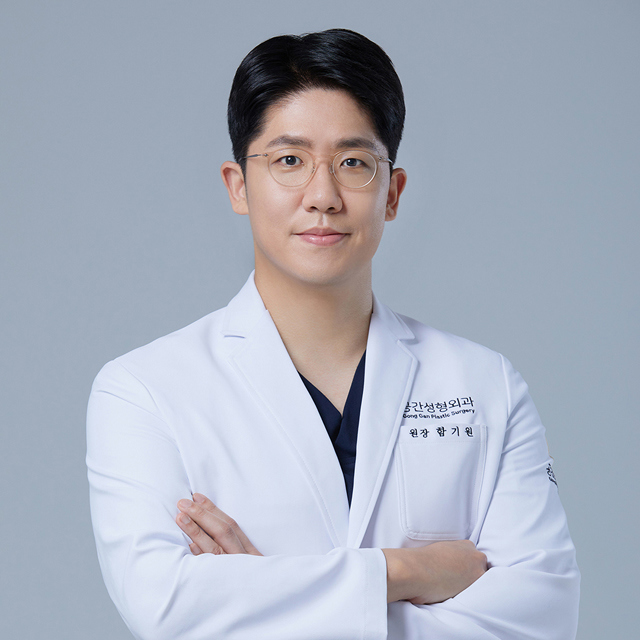
dr. Ki Weon Ham Dokter Spesialis Bedah Plastik
Gonggan Plastic Surgery is led by Representative Director Dr. Ki Weon Ham, a board-certified plastic surgeon with 17 years of clinical experience and a training background spanning Korea's most prestigious medical institutions and leading international surgical centers.
Dr. Ham completed his medical degree at Yonsei University College of Medicine and his plastic surgery residency at Severance Hospital. He then undertook advanced fellowships at the University of California San Diego Medical Center (UCSD) and the University of Pittsburgh Medical Center (UPMC), before returning to Severance as a Former Clinical Instructor in Plastic Surgery. Gonggan operates as an official partner clinic of Yonsei University Severance Hospital.
He holds Life Membership and serves on the Academic Committee of the Korean Society of Plastic and Reconstructive Surgeons (KSPRS), presenting regularly at KSPRS international academic conferences. He is also a full member of KSAPS, KCPCA, and IPRAS.
Dr. Ham's approach to ptosis correction is grounded in a commitment to accurate diagnosis and honest guidance. His philosophy is straightforward: recommending double eyelid surgery to a patient with undiagnosed ptosis is not a solution — it is a pathway to revision. Every eye surgery consultation at Gonggan begins with a thorough evaluation of the actual cause, and every surgical plan is built only around what is genuinely necessary to achieve a natural, balanced, and lasting result.
[Book a Consultation with Dr. Ki Weon Ham]
Ptosis Correction Techniques at Gonggan Plastic Surgery
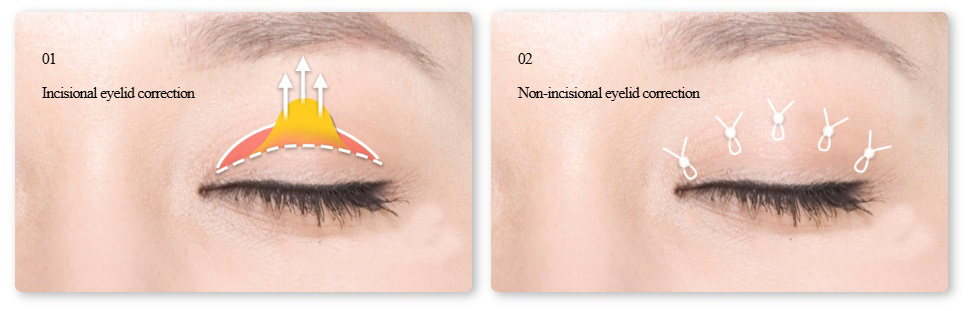
- Incisional Ptosis Correction — For Moderate to Severe Ptosis: When ptosis is pronounced, the levator palpebrae superioris muscle has typically stretched or weakened to a degree that requires direct surgical repair. In this approach, an incision is made along the eyelid to access the muscle directly, allowing Dr. Ham to shorten and re-anchor the stretched portion of the levator to restore effective eyelid lifting. Where excess eyelid fat is also contributing to a heavy or covered appearance, it can be removed during the same procedure. The incision is placed carefully to minimize visible scarring and to simultaneously create a clean, naturally defined eyelid crease that complements the corrected eyelid opening. This approach delivers the most comprehensive correction for patients with significant ptosis.
- Non-Incisional Ptosis Correction — For Mild Ptosis: When ptosis is mild and the levator muscle retains reasonable functional strength, a less invasive approach is possible. Micro-perforations are made in the eyelid skin — too small to require formal incisions — through which the weakened muscle is directly connected to the overlying skin. This tightens the functional link between the muscle and the eyelid surface, restoring a more open and alert eye appearance without the recovery demands of a full incision. The result is a natural improvement in eyelid opening with minimal tissue disruption and a shorter healing period. The technique is selected only when the degree of ptosis is genuinely suitable for a non-incisional approach — never applied as a default regardless of severity.
Beyond technique selection, ptosis correction at Gonggan also considers the shape of the lash line. A well-corrected eyelid should not simply open wider — the lower edge of the upper eyelid should follow a stable, naturally curved arc that creates a balanced and aesthetically pleasing eye shape from all angles. This detail is incorporated into the surgical design of every ptosis correction case.
Individual results vary depending on the degree of ptosis, muscle strength, skin condition, and healing response. Realistic expectations are discussed in full during pre-operative consultation, and no specific outcome can be guaranteed.
The Ptosis Correction Process at Gonggan Plastic Surgery
- Diagnostic Evaluation and Ptosis Assessment: The consultation begins with a thorough evaluation of the eyelid's functional and aesthetic characteristics — levator muscle strength, degree of eyelid droop, pupil exposure range, skin thickness, and eye-opening habits. This assessment determines whether ptosis is present, its severity, and whether it is the primary cause of the patient's concern or a contributing factor alongside other conditions.
- Honest Surgical Guidance and Goal-Setting: Dr. Ham discusses the findings openly — including whether double eyelid surgery alone would be insufficient and why ptosis correction is or is not indicated. The achievable range of improvement, the most appropriate technique, and realistic expectations are all communicated clearly before any surgical plan is confirmed.
- Personalized Surgical Plan: A fully individualized plan is developed based on the diagnostic findings and patient goals. The technique — incisional or non-incisional — is selected based on ptosis severity and individual anatomy. Only the procedures that are genuinely necessary are included; no additional surgery is recommended without clear clinical justification.
- Ptosis Correction Procedure: Dr. Ham performs the surgery directly, using clean, precise technique designed to minimize scarring and support efficient recovery. The degree of levator correction is calibrated to the individual patient's muscle strength and desired eyelid opening — neither under-correcting nor over-correcting. Lash line curvature and overall eyelid balance are incorporated into the surgical design.
- Post-Operative Care and Recovery: Mild swelling and bruising are expected and typically resolve within one to two weeks. A dedicated post-operative management program is provided, with a specialist care coordinator guiding recovery and monitoring progress toward the final result.
- Follow-Up and Outcome Monitoring: Dr. Ham personally oversees all follow-up appointments. Eyelid opening and shape become progressively clearer as swelling resolves, with the final corrected appearance continuing to stabilize over the following weeks.
Results, Safety, and Longevity of Ptosis Correction
 |
 |
 |
 |
|---|
Ptosis correction at Gonggan is designed for durable, functionally sound results. By repairing the levator muscle directly — rather than masking a droopy appearance with a cosmetic fold — the correction addresses the structural cause and produces an outcome that remains stable over time. The degree of correction is carefully calibrated to the individual patient's muscle function to minimize the risk of under- or over-correction.
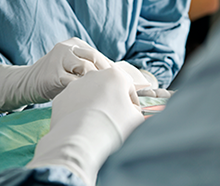
All procedures are supported by hospital-grade safety systems: operating room CCTV monitoring confirming that Dr. Ham performs every surgery personally, and multi-stage sterilization protocols exceeding standard medical guidelines. The clinic's commitment to recommending only necessary procedures is a core patient safety principle — patients are never advised toward additional surgery without clear clinical indication.
As with any surgical procedure, ptosis correction carries inherent risks including temporary swelling, bruising, asymmetry during healing, and a low risk of infection. The degree of eyelid opening achieved can be influenced by individual healing patterns and muscle response. Serious complications are rare but possible and are discussed openly during pre-operative consultation.
Why Choose Gonggan Plastic Surgery for Ptosis Correction?
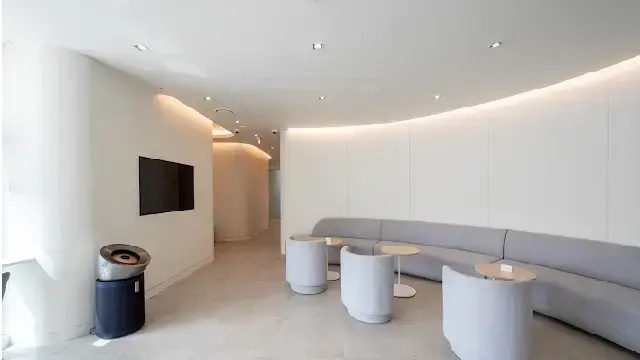
Gonggan Plastic Surgery's combination of university-hospital-level diagnostic precision — as an official partner clinic of Yonsei University Severance Hospital — and a dedicated single-surgeon boutique practice model makes it well-suited to the demands of ptosis correction. Accurate diagnosis, honest communication, and a no-unnecessary-surgery philosophy are the defining features of the clinic's approach to eye surgery.
Dr. Ham's 17 years of experience, UCSD and UPMC fellowships, and regular academic engagement through KSPRS mean every ptosis correction case is approached with both clinical depth and current research awareness. His all-in-one care model ensures he personally manages every stage — from initial evaluation through surgical planning, the procedure, and post-operative follow-up — with complete continuity and no rotating surgeons.
- Diagnosis Before Surgery: Every patient presenting with droopy or sleepy eyes receives a thorough ptosis assessment before any surgical recommendation is made — preventing misdiagnosis and avoiding unnecessary double eyelid procedures
- Only Necessary Procedures: Dr. Ham recommends only what is genuinely clinically indicated — honest, objective guidance is a foundational commitment at Gonggan
- Full Surgical Transparency: OR CCTV monitoring confirms every procedure is performed exclusively by Dr. Ham, providing complete confidence in surgical accountability
Patient Experiences: Ptosis Correction at Gonggan Plastic Surgery
Non-Incisional Ptosis Correction Patient, 20s
This patient had always felt her eyes appeared tired and smaller than she would like, and had previously been advised elsewhere to undergo double eyelid surgery. At Gonggan, Dr. Ham's evaluation identified mild ptosis as the primary cause. Non-incisional ptosis correction was performed, directly connecting the weakened levator muscle to the eyelid skin. At follow-up, she noted a visibly more open, alert eye appearance with a natural lash curve — and was relieved that the correct procedure had been identified before proceeding.
Incisional Ptosis Correction Patient, 30s
A patient with moderate ptosis that had become progressively more noticeable underwent incisional levator repair at Gonggan. Dr. Ham corrected the stretched muscle directly and removed a small amount of excess eyelid fat during the same procedure. The patient reported a comfortable recovery and noted at follow-up that his eyes appeared significantly more open, balanced, and natural — without any appearance of over-correction.
Ready for More Open, Naturally Balanced Eyes? Start with an Accurate Diagnosis.
If droopy, tired-looking, or partially covered eyes are affecting your appearance and confidence, ptosis correction at Gonggan Plastic Surgery offers a precisely diagnosed, individually planned surgical solution. Dr. Ki Weon Ham combines 17 years of clinical expertise, Severance Hospital training, UCSD and UPMC fellowships, and KSPRS Academic Committee membership to deliver eye opening surgery grounded in accurate diagnosis, honest guidance, and anatomical precision. From initial evaluation to final recovery, every stage is managed directly by Dr. Ham — ensuring your eyes are assessed correctly and corrected with the care and detail they deserve.
[Book Your Ptosis Correction Consultation at Gonggan Plastic Surgery]
Other Services
Explore additional treatments offered by our specialists.

Facelift
A facelift — is a surgical procedure that addresses deep wrinkles, comprehensive skin sagging, and the structural descent of facial tissue by lifting and repositioning the facial soft tissue at the deep structural level.
Learn More

Alar Reduction
Alar base reduction — is a surgical procedure that narrows the width of the nostrils and alar base to create a more refined and proportionate nasal appearance.
Learn More

Double Eyelid Surgery
Double eyelid surgery — also known as blepharoplasty or eyelid crease surgery — creates or refines a fold in the upper eyelid to produce a more defined, open, and balanced eye appearance.
Learn More